


What is Executive Coaching?
What is Executive Coaching?
It deeply impacts the participating executive and it also touches everyone the leader interacts with (which tends to be almost everyone in the organization).
This article is aimed at demystifying the Executive Coaching process so that more top-level leaders feel comfortable engaging in this powerful process.
Definition of Executive Coaching:
Executive coaching helps an executive keep an ongoing focus on their own leadership development which results in continuous learning and exponential improvement.
The Purpose of Executive Coaching
Who Needs an Executive Coach?
As with elite athletes (tennis players, swimmers, football players, golfers) and successful artists (musicians, singers, newscasters, actors), a coach brings an outside perspective and expertise in improving performance in the participant’s area of excellence.
“I absolutely believe that people, unless coached, never reach their maximum capabilities.”
– Bob Nardelli, President & CEO of Home Depot
When to Engage an Executive Coach
There are, however, specific times in a leader’s career when it’s especially helpful to engage an Executive Coach. For example, when a leader:
- Has a significant change in their responsibilities
- Receives a promotion
- Changes jobs
- Is aiming to move up to the next level of leadership
- Gets passed over for a promotion
- Joins a new organization (e.g., making a “First 90 Days” plan and executing it)
- Needs to develop a new skill
- Has a significant change in their team lineup changes significantly
Reasons Executive Coaching is Offered to a Leader
However, occasionally, a company Board or CEO will provide an Executive with Executive Coaching Services as support to correct a flaw that threatens their tenure as a leader in the company. A “Corrective” Coaching engagement can support the Executive in improving to retain their position if the client is committed to changing, works hard, and digs deep to make the necessary change(s).
In addition, “Corrective” Coaching may not be as effective as development-centered Executive Coaching because the client is under duress due to the possibility of losing their position and often isn’t given a choice about engaging with the Executive Coach or not. In these situations, it’s more challenging to create the trust between the client and Coach that is necessary to delve deep into the client’s beliefs, thinking, and perspective (drivers of the leader’s behavior).
However, proactive, developmental Executive Coaching is the most effective approach.
What to Look for in an Executive Coach?
In addition, Executive Coaches should have knowledge of:
- Leadership methods, principles, and approaches
- How executive-level leaders lead and develop their direct reports
- Leadership skills needed by executive leaders
- The types of problems and challenges Executives face
- How to support executives in leveraging their strengths and mitigating their weaknesses
- How to stimulate strategic thinking in a leaders
- The relationship between the C-Suite and the Board
- The fundamentals of business through first-hand business experience
Length of Executive Coaching Engagements
Some Executives work with an Executive Coach for their entire tenure as an Executive. (I, myself have had a Coach for 16 years).
Most Executives meet with their Executive Coach at least two times per month.
The Basics of Executive Coaching
- Completely Customized: You work with your Coach to determine your goals for coaching, coaching session agendas, coaching approaches, and developmental actions.
- Just-in-Time: You can work on issues as they come up in your day-to-day work and apply new approaches immediately.
- Efficient: Your Coach will help you manage your Coaching session, so you get a great deal done in a very concentrated amount of time.
- Enhances Other Forms of Learning: Coaching will help you bring the principles you learn from books, articles, podcasts, and training into your work. Coaching supports real world implementation of new or improved skills and learning.
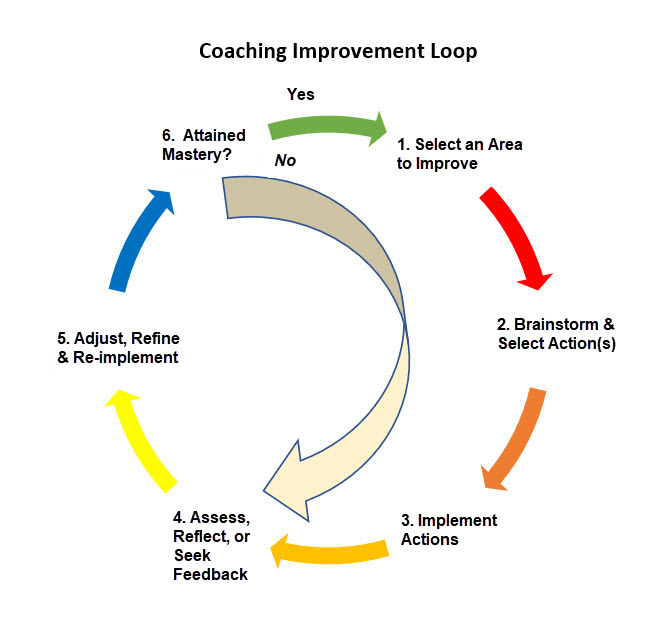
- Iterative: You can determine a course of action, try it at work, review it with your Coach, redesign it, and try it again in an improvement cycle that creates success. (See the Coaching Improvement Loop diagram below).
Examples of Real Executive Coaching Goals
- Build a more collaborative relationship with the Engineering department
- Increase leadership presence with the Board and peers
- Improve my Personal Brand
- Become more persuasive with a selected customer or selected peer
- Strategize on how to create business alliances with our vendors
- Select a tailored approach to manage each leader on my team
- Develop strategies to meet my boss’ expectations
- Enhance emotional intelligence to improve conflict management with my peers
Examples of Executive Coaching Session Activities
- Goal Setting
- Examining deep questions
- Brainstorming
- Planning
- Decision-making
- Debriefing assessments and inventories
- Strategizing on how to apply leadership theory, methods, and approaches to day-to-day leadership
- Reinforcing positive changes
- Adjusting to overcome barriers to change
- Skill practice
- Roleplaying
- Celebrating successes
- Guided imagery for creating success
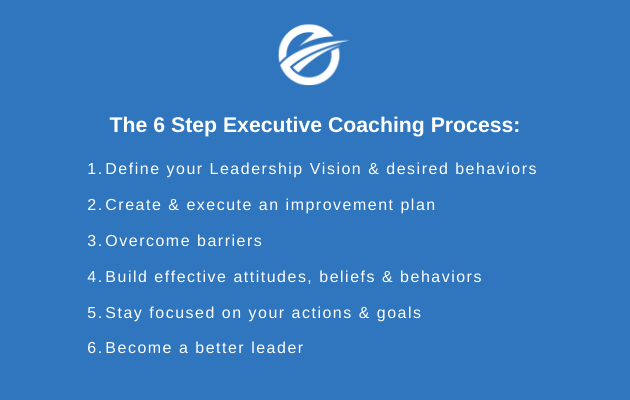
There are 6 main steps in the Executive Coaching Process as pictured in the image below.
Executive Coach as Confidential Sounding Board
In addition, Certified Executive Coaches are safe confidants because they are bound by the ICF* Code of Ethics to keep a client’s information confidential.
Experts in helping clients create and execute their leadership development action plans, Executive Coaches are invaluable to Executives.
“As I talk to my Coach about a business strategy, the steps come tumbling out and I’m able to create a plan and see what I need to put that plan into action. I know I wouldn’t do it as quickly if I didn’t have a Coach. By the way, I’m sure my husband is grateful I have a coach. He often gently says: “maybe you could talk to your Coach about that.”
—Executive Coaching Client
Benefits of Executive Coaching for Leaders
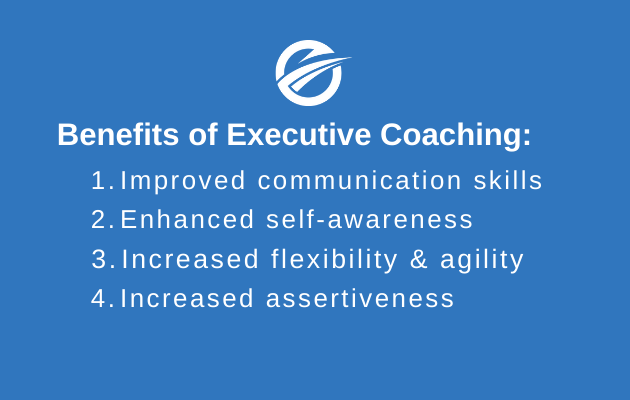
- Enhanced self-awareness
- Improved communication skills
- Reduced conflict
- Stronger more independent teams
- Expanded flexibility and agility
- Increased assertiveness (aggressive to assertive or passive to assertive)
- Greater ability to optimize leadership behavior for each situation
- Refined leadership skills
- Ignited motivation and passion
- More creativity and innovation
- Better time management
- Decreased stress
- Work/life balance
Benefits of Executive Coaching for the Organization
“Employers are shocked at how high their ROI numbers are for coaching. Having a Management Coach helps leaders create the right priorities, take time to examine the big picture, and anticipate and prevent problems.”
– Alastair Robertson, Manager of Worldwide Leadership Development for Accenture
One of the most important benefits an organization receives from implementing Executive Coaching is leader retention. It’s extremely costly to recruit, hire, and train an executive. The investment a company makes into coaching shows caring and commitment to the leader, which has been proven to increase leader retention.
The benefits of Executive Coaching for an organization include:
- Increased employee retention
- Executive and leader retention
- Reduced leader burnout
- More effective succession planning
- Improved leader productivity and performance
- Decreased human resources issues
- Better conflict management
- Enhanced change management
Executive Coaching greatly impacts employees and customers. We often see leaders and employees leave a company because there has been three CEOs in 2 years, or many changes in the C-Suite. The fact that Executive Coaching greatly impacts Executive retention should make it a high priority for every company.
Leadership Coaching Versus Executive Coaching
If a distinction is drawn between the two terms, it’s most often based on the level of leadership position the client holds:
- Executive Coaching: C-Suite, President, General Manager (GM), Legal Counsel, Senior Vice President (SVP), and Vice President (VP) leadership levels
- Leadership Coaching: any leader below VP (e.g., Directors, Managers, Supervisors, Leads, Project Managers, Program Managers, or professionals with high potential for entering management)
You could say that Executive Coaching is a subset of Leadership Coaching.
Over the years, we have adopted this terminology.
The Focus of Executive Coaching versus Leadership Coaching
Here’s a comparison of Executive-level coaching topics versus Leadership Coaching topics.
| Executive Coaching | Leadership Coaching | • Big picture thinking | • Big picture thinking with regard to the services their department provides | • Company business strategy | • Departmental business strategy | • Effective strategic planning | • Effective departmental strategic planning | • Communicating effectively with the board
• Communicating effectively with shareholder |
• Communicating effectively with upper management
• Communicating effectively with your boss |
• Effectively managing the relationships with the Board, shareholder, customer upper management | • Effectively managing staff, peer, stakeholder, vendor, department level customer relationships | • Inspiring high-level leaders and the entire company | • Inspiring and motivating managers and/or professionals and/or frontline workers | • Building a high-performing Executive Leadership Team (ELT) or upper level leadership team | • Building a high-performing team | • Hiring for upper management roles | • Hiring directors, managers, supervisors, staff | • Building Executive presence | • Building leadership presence | • Creating an effective company culture | • Creating a productive department culture | • Preparing for TV interviews | • Large-scale public speaking |
- The art of persuasion and negotiation
- Leveraging failure
- Being an encouraging leader
- Developing a Coach Approach to leadership
- Navigating company politics
- Time management
- Task prioritization
- Eliminating overwhelm
- Work/Life Balance
Training Versus Executive Coaching
Coaching is also more convenient than training, as your coaching sessions will be on the phone or on Zoom. You won’t need to leave your office. This means that the time you put into Coaching is just Coaching, not traveling to and from a classroom or office.
Coaching also creates just-in-time learning as leaders can bring current issues and challenges to discuss with their Executive Coach and apply what they’ve learned to the situation immediately.
Executive Coaching Addresses the Whole Person
Executive Coaching often delves into personal situations and issues, which supports the leader in becoming more effective in their professional endeavors.
Further, an executive’s level of stress, health, personal relationships, and sense of personal wellbeing impacts their performance at work.
Executive Coaching Can Help You Become the Best Leader You Can Be
Whatever your Coaching Goals are, you will make progress toward attaining them from your first Coaching session and will continue to make progress that will build exponentially over the time you work with your Executive Coach.
Further, the positive impact realized through Executive Coaching will ripple through all the people the Executive interacts with (the board, peers, direct reports, staff, customers, and vendors) and through all of these people to the people they interact with.
When you engage an Executive Coach, you are doing a great thing for yourself, your work, and your personal community.
Contact Donna Schilder, MCC, President, Glacier Point Solutions at:
Donna@DonnaSchilder.com
(562)434-7822
Be the Leader you’ve always wanted to be!
[book_a_consult][/book_a_consult]
© Donna Schilder, MCC, Leadership, Career, & Business Coach of Glacier Point Solutions, Inc., 2012. Donna@DonnaSchilder.com (562)434-7822. You are welcome to reprint
this article online as long as it remains complete and unaltered (including the About the author
information at the end).

Donna Schilder is a Leadership Coach, Career Coach, & Business Coach who provides a place for her clients to stand back, assess situations, reconnect to their goals, and choose the best approach to achieve business and personal success.