
The Hersey-Blanchard Situational Leadership Theory
Management experts Paul Hersey and Ken Blanchard argue that these things happen because leaders don’t match their style of leadership to the maturity of the person or group they’re leading. When style and maturity aren’t matched, failure is the result.
In this article, we’ll review the Hersey-Blanchard Situational Leadership Theory, and explain how it is used in different leadership situations.
The Origin of the Hersey-Blanchard Situational Leadership Theory
Leadership Styles
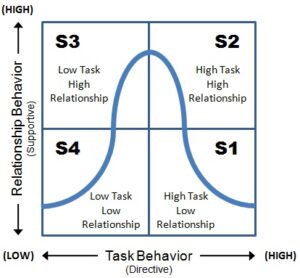
- Telling (S1) – Leaders tell their people exactly what to do, and how to do it.
- Selling (S2) – Leaders still provide information and direction, but there’s more communication with followers. Leaders “sell” their message to get the team on board.
- Participating (S3) – Leaders focus more on the relationship and less on direction. The leader works with the team, and shares decision-making responsibilities.
- Delegating (S4) – Leaders pass most of the responsibility onto the follower or group. The leaders still monitor progress, but they’re less involved in decisions.
As you can see, styles S1 and S2 are focused on getting the task done. Styles S3 and S4 are more concerned with developing team members’ abilities to work independently.
Maturity Levels
- M1 – People at this level of maturity are at the bottom level of the scale. They lack the knowledge, skills, or confidence to work on their own, and they often need to be pushed to take the task on.
- M2 – At this level, followers might be willing to work on the task, but they still don’t have the skills to do it successfully.
- M3 – Here, followers are ready and willing to help with the task. They have more skills than the M2 group, but they’re still not confident in their abilities.
- M4 – These followers are able to work on their own. They have high confidence and strong skills, and they’re committed to the task.
The Hersey-Blanchard Situational Leadership Theory maps each leadership style to each maturity level, as shown below. S1 is most appropriate for M1; S2 is best suited for M2; and so on.
Leadership Style Examples
- You’re about to leave for an extended holiday, and your tasks will be handled by an experienced colleague. He’s very familiar with your responsibilities, and he’s excited to do the job.
- Instead of trusting his knowledge and skills to do the work, you spend hours creating a detailed list of tasks for which he’ll be responsible, and instructions on how to do them.
- The result? Your work gets done, but you’ve damaged the relationship with your colleague by your lack of trust. He was an M4 in maturity, and yet you used an S1 leadership style instead of an S4, which would have been more appropriate.
- You’ve just been put in charge of leading a new team. It’s your first time working with these people. As far as you can tell, they have some of the necessary skills to reach the department’s goals, but not all of them. The good news is that they’re excited and willing to do the work.
- You estimate they’re at an M3 maturity level, so you use the matching S3 leadership style. You coach them through the project’s goals, pushing and teaching where necessary, but largely leaving them to make their own decisions. As a result, their relationship with you is strengthened, and the team’s efforts are a success.

